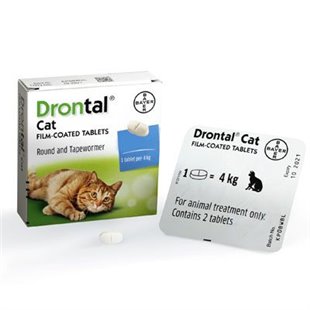
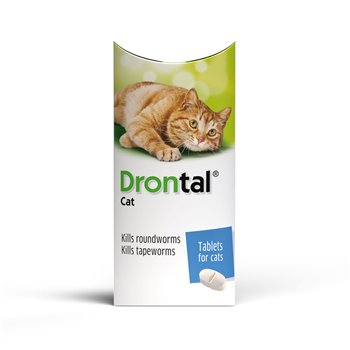
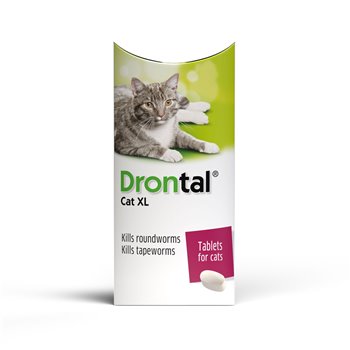
Drontal Cat Wormer is a broad-spectrum worming treatment designed to clear the most common intestinal worms seen in cats. Drontal Cat Wormer is used to treat roundworms (intestinal nematodes) and tapeworms (cestodes), which are responsible for most routine infestations. Worm burdens can build up quietly, so routine worming is often recommended even when a cat appears well.
Worms in cats are caused by helminth parasites that live in, or pass through, the gastrointestinal tract. Roundworms such as Toxocara cati are especially common in kittens because larvae can be passed from mother to kitten via milk, and eggs (ova) shed in faeces can survive in soil for long periods. Tapeworms are often linked to fleas; a cat swallows an infected flea during grooming, and the tapeworm develops inside the intestine. Cats can also pick up parasites through hunting, scavenging, exposure to contaminated gardens, or sharing a litter tray with other animals. Even indoor cats can be affected, because flea exposure can happen in any home and worm eggs can be carried in on shoes. Some worms in cats have zoonotic potential, meaning they can pose a health risk to people, particularly children, through accidental ingestion of microscopic eggs. Good hygiene around litter trays and regular parasite control reduce that risk and help keep your household safer.
Not every cat with worms will look obviously unwell, which is one reason worms in cats are easy to miss. The signs depend on the species involved, the number of parasites present, and your cat’s age and immune status. You might notice one or more of the following:
- Your cat may vomit or have intermittent diarrhoea, sometimes with mucus.
- Your kitten may develop a bloated or “pot‑bellied” appearance.
- Your cat may lose weight or fail to gain weight despite a good appetite.
- You may notice a dull coat, flaky skin, or a generally “off‑colour” look.
- Your cat may scoot, lick at the rear end, or you may see tapeworm segments in the litter tray.
- Your cat may seem lethargic or dehydrated, or you may notice pale gums from anaemia in heavy burdens.
With roundworms, it is possible to see spaghetti-like worms in vomit or faeces, although many cats never show anything obvious. Because larvae can migrate during their life cycle, a mild cough may occasionally be noticed in kittens. If your cat is very young, pregnant, elderly, or has an underlying condition, even a moderate infestation can have a bigger clinical impact, and prompt treatment is sensible.
Drontal Cat Wormer is intended to treat established intestinal infestations, and it can also be used as part of a routine worming plan to reduce reinfection. Many veterinary parasite-control programmes recommend more frequent worming for kittens and for adult cats that hunt or live in multi‑pet households. A faecal examination (microscopy to look for eggs) can help confirm worms in cats, but it is not always performed for routine control because egg shedding can be intermittent and a single sample may miss a low-level infestation. If your cat has persistent diarrhoea, repeated vomiting, unexplained weight loss, or you suspect a heavy burden, a veterinary assessment is important so that dehydration, pancreatitis, dietary intolerance, inflammatory bowel disease, or other conditions are not overlooked. Drontal Cat Wormer treats intestinal roundworms and tapeworms, but it will not treat fleas and it is not designed for every parasite, such as lungworm, so overall parasite prevention should be tailored to your cat’s lifestyle.
Drontal Cat Wormer works by using active ingredients that target worms in different ways, which helps achieve broad coverage. In the tablet formulation commonly supplied for cats, praziquantel acts against tapeworms by altering calcium movement across the parasite’s cell membranes. This causes rapid muscle contraction and paralysis, and it disrupts the worm’s outer surface (the tegument), leaving it unable to maintain its normal structure within the intestine. Pyrantel embonate is active against many roundworms by acting as a depolarising neuromuscular blocking agent. In simple terms, it interferes with nerve signalling in the worm, leading to spastic paralysis so the parasite loses its grip on the intestinal wall. Once immobilised, worms are carried out of the body through normal gut motility (peristalsis) and passed in the faeces. Drontal Cat Wormer does not “sterilise” the environment, so reinfection can occur if your cat continues to hunt, share spaces with other pets, or swallow fleas. That is why worming is usually paired with good litter tray hygiene, prompt removal of faeces, and effective flea control when tapeworm is suspected.
When giving Drontal Cat Wormer, accurate weight-based dosing is essential, because the dose is calculated to provide an effective anthelmintic level without unnecessary exposure. Tablets are usually given directly by mouth or hidden in a small amount of food. Dosing is often easiest when your cat is calm. Try to ensure the full dose is swallowed, and avoid mixing it into a full meal in case your cat leaves part behind. If you are treating worms in cats after a flea problem, pairing Drontal Cat Wormer with a reliable flea treatment is important, as tapeworm reinfection can occur if fleas remain in the home. Most cats tolerate Drontal Cat Wormer well, but mild, short-lived side effects can occur, including vomiting, loose stools, reduced appetite, or hypersalivation. Contact a vet promptly if your cat seems unwell after dosing, if symptoms are severe, or if your cat is a kitten or has a history of medical problems. In households with children or immunocompromised people, handwashing after handling litter, keeping sandpits covered, and regular parasite control are particularly important steps when managing worms in cats.
What worms does Drontal Cat Wormer treat?
Drontal Cat Wormer is designed to treat common intestinal roundworms (nematodes) and tapeworms (cestodes) in cats. It is useful for routine deworming and when worms are suspected. If your cat has coughing, breathing changes, or other signs that could indicate lungworm, ask your vet for tailored testing and treatment.
How often should I worm my cat with Drontal Cat Wormer?
Worming frequency depends on lifestyle. Many vets suggest routine control for adult cats every three months, but hunting cats or multi‑pet households may need more frequent treatment. Kittens usually require a closer schedule because they are more vulnerable. Follow the Drontal Cat Wormer instructions and your vet’s advice for your cat.
Can indoor cats get worms?
Yes. Worms in cats are not limited to outdoor pets. Indoor cats can swallow fleas that carry tapeworm, and roundworm eggs can be brought indoors on footwear or by visiting animals. Regular hygiene around litter trays, prompt flea control, and an appropriate worming routine, such as Drontal Cat Wormer, help reduce risk.
Are worms in cats contagious to humans?
Some roundworms are zoonotic, meaning people can be exposed to eggs shed in cat faeces. Risk is higher for young children, who may accidentally ingest microscopic eggs from contaminated soil or litter. Regular worming (for example with Drontal Cat Wormer), careful litter tray hygiene, and handwashing are practical protective steps.
When should I speak to a vet instead of worming at home?
Seek veterinary advice if your cat is very young, pregnant, chronically ill, losing weight quickly, or has persistent vomiting, diarrhoea, or blood in the stools. Also speak to a vet if you keep finding worms despite treatment, or if you suspect parasites not covered by Drontal Cat Wormer, such as lungworm.