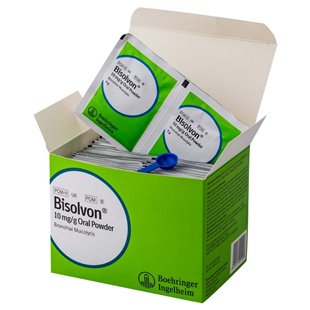
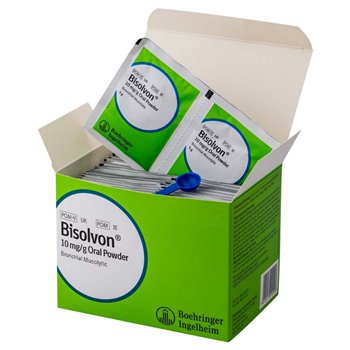
Bisolvon Powder is a mucolytic (mucus‑loosening) prescription medicine that veterinary surgeons may prescribe for dogs and cats when thick, sticky secretions are contributing to cough, congestion, or “chesty” breathing.
VETERINARY PRESCRIPTION REQUIRED
During respiratory disease, the lining of the airways can become inflamed and swollen, and the body often produces more mucus as a protective response. If that mucus becomes unusually tenacious, it can sit in the trachea and bronchi, narrow the airway lumen and trigger repeated coughing as your pet tries to clear it. In practice, many pets feel most uncomfortable not because they are producing mucus, but because the mucus is too thick to shift.
Bisolvon is used to change the character of those secretions so they are easier to move, helping your pet’s normal clearance mechanisms work more efficiently. This can be especially reassuring for pets that sound congested but remain bright and responsive. Because coughing and noisy breathing can have several underlying causes, Bisolvon should only be used on veterinary advice, particularly if your pet has a heart murmur, suspected lungworm, a collapsing trachea, or a history of severe breathing episodes.
The active ingredient in Bisolvon is bromhexine hydrochloride. Bromhexine is described clinically as both a secretolytic and a secretomotor agent. Secretolytic activity means it reduces the viscosity and elasticity of mucus, helping to disrupt the molecular structure that makes secretions thick and sticky. Secretomotor activity means it supports the movement of mucus along the respiratory tract. Bisolvon does this by aiding normal mucociliary clearance, the natural “conveyor belt” action where tiny hairs (cilia) on the respiratory epithelium move mucus upwards towards the throat. As the mucus becomes less tenacious, coughing can become more productive, which is often what a vet aims for when there is retained material in the airways. By supporting clearance of secretions from the tracheobronchial tree, Bisolvon can help reduce airway obstruction, improve ventilation, and make breathing sound and feel calmer while the underlying condition is treated.
Veterinary surgeons may consider Bisolvon when a dog or cat has signs consistent with mucus‑rich airway disease, such as acute or chronic bronchitis, tracheobronchitis, or lower respiratory tract infection where secretions are difficult to clear. Bisolvon does not treat infection, parasites, allergic disease, or inflammation on its own, but it can be a useful adjunct alongside therapies your vet chooses, such as antibiotics, anti‑inflammatories, bronchodilators, nebulisation, humidification, or physiotherapy techniques. In practice, Bisolvon is most helpful when there is something to loosen and move, rather than a purely dry, irritative cough. Signs that may prompt a vet to discuss Bisolvon include:
- You may notice a moist or “chesty” cough that is often worse after sleep, excitement, or exercise.
- You may hear audible congestion or “gurgly” breathing, or your vet may hear crackles on auscultation.
- Your pet may have thick nasal discharge or repeated sneezing with sticky mucus.
- Your pet may gag or retch at the end of coughing as secretions shift upwards
- Your pet may tire quickly, breathe faster (tachypnoea), or breathe with effort (dyspnoea) because air movement is restricted.
If your pet is open‑mouth breathing, breathing with obvious effort, has pale or blue‑tinged gums, or cannot settle comfortably, it is important to seek urgent veterinary advice, whether or not Bisolvon is being used.
In dogs, Bisolvon is often chosen when mucus and airway inflammation are maintaining a cough cycle. Infectious tracheobronchitis (commonly called kennel cough) can start as a harsh, dry cough and sometimes becomes more productive, particularly if secondary bacterial infection or lower airway involvement develops. Dogs with chronic bronchitis, especially middle‑aged to older individuals, may produce ongoing bronchial secretions that irritate the airway lining and contribute to bronchial hyper‑reactivity, so the cough persists and the airways remain inflamed.
In these situations, Bisolvon can be used to support expectoration, helping the dog clear secretions more effectively while the vet addresses triggers and inflammation. Practical supportive measures such as avoiding cigarette smoke or aerosols, using a harness instead of a collar, keeping walks gentle, and ensuring good hydration can complement the intended action of Bisolvon. Your vet may also advise rest and careful monitoring of breathing rate and effort, because a worsening cough can indicate progression to pneumonia or another complication that needs prompt treatment.
Cats can be more subtle with respiratory disease and may swallow mucus rather than coughing it up, so congestion may present as snuffling, stertor (noisy upper‑airway breathing), reduced appetite, lethargy, or a change in vocalisation due to throat irritation. Bisolvon may be prescribed when thick secretions are part of the clinical picture in feline upper or lower respiratory disease, helping to thin mucus so it can be cleared more efficiently by the mucociliary escalator.
This can be particularly helpful when a cat has “gummed‑up” nasal passages that interfere with smell and eating, or when mucus within the bronchi contributes to coughing and airway discomfort. Bisolvon may be used alongside treatments such as antibiotics, antiviral or anti‑inflammatory therapy where appropriate, and supportive care like humidified air, gentle warming of food, and maintaining fluid intake. If a cat is breathing with effort, has persistent rapid breathing, or stops eating, a vet should assess promptly, as cats can deteriorate quickly when respiratory function is compromised.
Bisolvon Powder is given orally, and your vet will advise the exact dose, frequency, and duration for your individual pet based on bodyweight, diagnosis, age, and concurrent medicines. The powder can often be mixed with a small amount of palatable food or dissolved as directed so the full amount is taken, but it is important that your pet consumes the entire portion to receive the intended dose. Bisolvon is generally well tolerated, but any medicine can cause unwanted effects, and some pets may develop mild gastrointestinal upset such as soft stools, vomiting, or transient nausea. Rarely, hypersensitivity reactions can occur, so contact your vet if you notice facial swelling, hives, marked itching, or sudden worsening of breathing. Let your vet know about any other medicines or supplements your pet is taking, and about underlying liver or kidney disease, pregnancy, or lactation, as these factors can affect how treatment is chosen. If clinical signs fail to improve, recur, or worsen while using Bisolvon, the safest next step is reassessment rather than continuing without guidance.
How does Bisolvon work in the lungs?
Bisolvon contains bromhexine, which reduces the viscosity and elasticity of respiratory mucus and supports mucociliary clearance. As secretions become less tenacious, coughing can be more productive and airways may feel less obstructed. Bisolvon is intended as supportive therapy alongside your vet’s wider treatment plan.
Is Bisolvon an antibiotic?
No. Bisolvon is not an antibiotic and it does not kill bacteria or viruses. Bisolvon works by thinning mucus so it can be cleared more effectively. If infection is suspected, your vet may prescribe antibiotics or other medicines in addition to Bisolvon, depending on examination and test results.
Can Bisolvon help with kennel cough?
Kennel cough can involve irritation of the trachea and bronchi, and some dogs develop thicker secretions as the condition progresses. In those cases, a vet may recommend Bisolvon to help loosen mucus and support expectoration. It does not replace rest, isolation, and veterinary assessment for complications.
How quickly does Bisolvon start working?
Bisolvon begins affecting mucus as it is absorbed, but how quickly you notice improvement depends on the cause and severity of disease. Some pets sound less congested within a day or two, while others need longer alongside antibiotics or anti‑inflammatories. If signs worsen or do not improve, contact your vet.
When should I contact a vet urgently about coughing or breathing problems?
Seek urgent help if your pet is breathing with obvious effort, open‑mouth breathing, has blue‑tinged or very pale gums, collapses, or cannot settle. Rapid breathing at rest, severe lethargy, repeated vomiting after coughing, or refusal to eat are also concerns. Do not wait for Bisolvon to ‘kick in’.