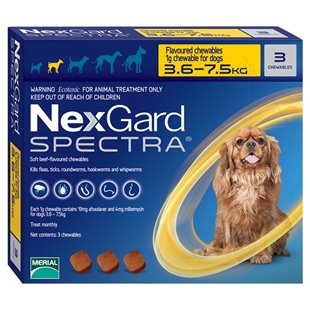
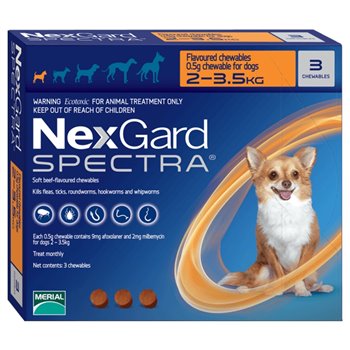
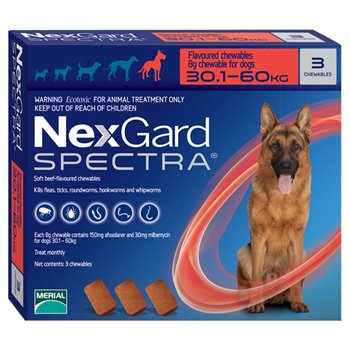
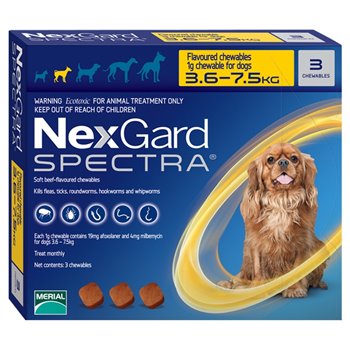
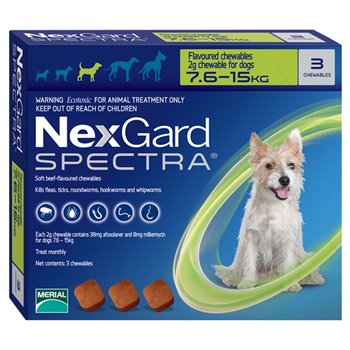
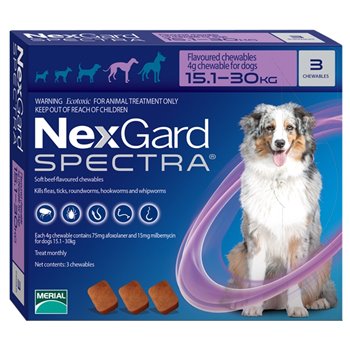
Nexgard Spectra for Dogs is a prescription-only oral antiparasitic tablet for dogs with, or at risk from, mixed infestations involving external and internal parasites such as fleas, ticks, mites and worms.
A Veterinary Prescription is required for Nexgard Spectra
Depending on veterinary assessment, Nexgard Spectra may be used against fleas, several tick species, Demodex mites, sarcoptic mange mites and ear mites, together with adult roundworms, hookworms or whipworms. Monthly administration may also be prescribed to prevent heartworm disease, reduce infection with the lungworm Angiostrongylus vasorum, and prevent establishment of Thelazia callipaeda eyeworm.
Nexgard Spectra for Dogs comes as a palatable chewable tablet, allowing systemic treatment without applying a liquid to the skin. This can reduce separate treatments when several clinically relevant parasite risks overlap during the same period.
Nexgard Spectra contains...
Nexgard Spectra for Dogs is a prescription-only oral antiparasitic tablet for dogs with, or at risk from, mixed infestations involving external and internal parasites such as fleas, ticks, mites and worms.
A Veterinary Prescription is required for Nexgard Spectra
Depending on veterinary assessment, Nexgard Spectra may be used against fleas, several tick species, Demodex mites, sarcoptic mange mites and ear mites, together with adult roundworms, hookworms or whipworms. Monthly administration may also be prescribed to prevent heartworm disease, reduce infection with the lungworm Angiostrongylus vasorum, and prevent establishment of Thelazia callipaeda eyeworm.
Nexgard Spectra for Dogs comes as a palatable chewable tablet, allowing systemic treatment without applying a liquid to the skin. This can reduce separate treatments when several clinically relevant parasite risks overlap during the same period.
Nexgard Spectra contains two active substances with complementary actions. Afoxolaner is an isoxazoline insecticide and acaricide. After the tablet is swallowed and absorbed, fleas, ticks and susceptible mites are exposed to afoxolaner when they feed. It blocks specific ligand-gated chloride channels in the parasite nervous system, particularly channels regulated by gamma-aminobutyric acid, or GABA. This causes uncontrolled neurological activity and death of the parasite. Fleas and ticks must attach and begin feeding before they are exposed, so no oral product can guarantee that transmission of every vector-borne infection will be prevented. Milbemycin oxime is a macrocyclic lactone endectocide. It alters glutamate-mediated chloride flow in susceptible nematodes, causing neuromuscular paralysis and death. By combining these mechanisms, Nexgard Spectra for Dogs can address a clinically relevant mixture of ectoparasites, which live on or in the skin, and endoparasites, which live within the body. It does not work as a repellent, and parasite control should still include regular coat checks and attention to the home environment.
Parasite infestations do not always produce one clear set of signs. Some dogs appear well despite carrying worms, while others develop skin, digestive or respiratory problems. A veterinary examination, parasite history and, where appropriate, tests such as faecal analysis, skin scrapings, blood testing or otoscopic examination can help identify the organisms involved. Signs that may justify prompt veterinary advice include:
- persistent scratching, biting or over-grooming;
- flea dirt, visible fleas or attached ticks;
- patchy hair loss, scaling, crusting or inflamed skin;
- head shaking, ear irritation or dark ear debris;
- vomiting, diarrhoea, poor growth, weight loss or a pot-bellied appearance;
- coughing, breathing changes, reduced stamina, unexplained bruising or bleeding.
These signs are not specific to parasites and can occur with allergies, bacterial or fungal infection, endocrine disease and other medical conditions. Nexgard Spectra for Dogs should therefore be selected for an individual dog on the basis of likely exposure, confirmed infestation and veterinary advice, rather than used to investigate undiagnosed symptoms by trial and error.
The parasite coverage of Nexgard Spectra for Dogs is broad but defined. It provides killing activity against fleas for five weeks and against listed tick species for four weeks, and flea control may form part of a management plan for flea allergy dermatitis. Treatment schedules for mites differ: demodicosis commonly requires repeated treatment and skin-scraping follow-up, sarcoptic mange is generally treated monthly for two consecutive months with further doses when clinically indicated, and ear mites may require reassessment after a single dose. A single appropriately prescribed dose treats susceptible adult gastrointestinal nematodes, but continuing flea and tick protection or prevention of heartworm, lungworm or eyeworm normally relies on timely repeat dosing. Nexgard Spectra for Dogs does not directly treat tapeworms, although killing fleas can reduce the risk of Dipylidium caninum transmission. It is also not an adulticide for established adult heartworm, so dogs living in or travelling to heartworm-endemic areas may need testing before a prevention programme begins.
What parasites does Nexgard Spectra for Dogs treat?
Nexgard Spectra for Dogs treats fleas, listed tick species, Demodex mites, sarcoptic mange mites, ear mites, and susceptible adult roundworms, hookworms and whipworms. With monthly administration, it can also prevent heartworm disease, reduce lungworm infection and prevent establishment of eyeworm, when these uses are clinically indicated.
How does Nexgard Spectra for Dogs work?
It combines afoxolaner and milbemycin oxime. Afoxolaner disrupts chloride channels in the nervous systems of fleas, ticks and susceptible mites. Milbemycin oxime interferes with nerve and muscle function in susceptible nematode worms. The parasites become paralysed or neurologically over-stimulated and then die.
How often should Nexgard Spectra for Dogs be given?
The dosing interval depends on the parasite being treated or prevented and the veterinary plan. Monthly dosing is commonly used for continuing flea and tick control and for heartworm, lungworm or eyeworm prevention. Some mite infestations require different schedules, so follow the prescription label rather than assuming every course is identical.
Does Nexgard Spectra for Dogs treat tapeworms?
Nexgard Spectra for Dogs does not directly kill tapeworms. Its flea-killing action can reduce the risk of Dipylidium caninum transmission because dogs acquire this tapeworm by swallowing infected fleas. A dog with a confirmed or suspected tapeworm infection may need a separate cestocidal medicine, usually containing an active substance such as praziquantel.
What side effects can Nexgard Spectra for Dogs cause?
Uncommon adverse effects include vomiting, diarrhoea, lethargy, reduced appetite and itching, and these are usually short-lived. Red skin and neurological signs, including poor coordination, tremors or convulsions, have been reported very rarely. Contact a veterinary surgeon promptly if signs are severe, persistent or neurological.
Can Nexgard Spectra for Dogs be given with food?
Yes. The chewable tablet can be offered directly, and it may be given with food when a dog will not accept it alone. Make sure the entire tablet is swallowed and use the correct whole-tablet strength. The tablets should not be divided, as this may lead to inaccurate dosing.