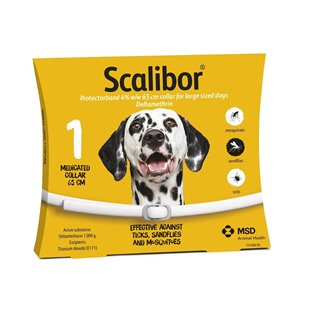
Scalibor Collars are a long-acting parasite-control collar for dogs, designed to help protect against external parasites (ectoparasites) such as ticks and biting insects. If your dog spends time in woodland, long grass, farms, kennels, or other high-risk environments, Scalibor Collars reduce the chance of skin inflammation and exposure to vector-borne disease.
Many dogs show little at first after a bite, while others develop localised redness (erythema), itching (pruritus), hair loss (alopecia), or sore “hot spots” that can become infected. Scalibor Collars offer easy protection for owners who prefer a collar-based option that is always in place.
Scalibor Collars work by releasing a controlled, low dose of deltamethrin, a synthetic pyrethroid with acaricidal (anti-tick) and insecticidal activity. Deltamethrin is lipophilic, which means it binds to the natural oils on your dog’s skin and coat; after the collar is fitted, the active ingredient gradually spreads across...
Scalibor Collars are a long-acting parasite-control collar for dogs, designed to help protect against external parasites (ectoparasites) such as ticks and biting insects. If your dog spends time in woodland, long grass, farms, kennels, or other high-risk environments, Scalibor Collars reduce the chance of skin inflammation and exposure to vector-borne disease.
Many dogs show little at first after a bite, while others develop localised redness (erythema), itching (pruritus), hair loss (alopecia), or sore “hot spots” that can become infected. Scalibor Collars offer easy protection for owners who prefer a collar-based option that is always in place.
Scalibor Collars work by releasing a controlled, low dose of deltamethrin, a synthetic pyrethroid with acaricidal (anti-tick) and insecticidal activity. Deltamethrin is lipophilic, which means it binds to the natural oils on your dog’s skin and coat; after the collar is fitted, the active ingredient gradually spreads across the body surface through the lipid layer and along the hair shafts. This creates a protective reservoir on the coat and skin rather than relying on a single application site.
Parasites are exposed mainly through contact, so protection is not limited to the neck area. Clinically, Scalibor Collars have both a repellent, anti-feeding effect and a killing effect: many insects are discouraged from biting, and those that do make contact can be affected. At a biological level, deltamethrin interferes with voltage-gated sodium channels in the parasite nervous system, causing hyperexcitability followed by paralysis and death. By reducing bites, Scalibor Collars may help lower exposure to pathogens carried by vectors, although no product can guarantee complete prevention of disease in every situation.
For Scalibor Collars to work as intended, they need to be worn continuously and fitted correctly. The collar should sit comfortably against the neck, with room for two fingers between the collar and the skin; this helps maintain contact without causing pressure or chafing. Any excess length should be trimmed according to the pack instructions, and the fit should be checked regularly in growing puppies or dogs whose weight changes.
Like many ectoparasiticides, there is usually a short period after first fitting while the active ingredient spreads over the skin and coat, so it is sensible to plan ahead before peak tick activity or travel. Normal outdoor life is generally compatible with Scalibor Collars, but very frequent shampooing or intensive grooming can reduce the surface lipid layer that helps distribute the product, so check the guidance if your dog is bathed often. If your dog is clipped very short or has a fine coat, keep an eye on the neck area for rubbing and keep the collar clean and dry. Avoid fitting the collar over broken or inflamed skin, because healthy skin supports better tolerance and more reliable distribution. Replace Scalibor Collars at the interval stated on the pack to maintain consistent protection.
Scalibor Collars are often chosen for dogs whose lifestyle brings regular exposure to ticks or biting flies, and they can be a helpful part of a broader preventive healthcare plan. Tick bites can transmit infections such as Lyme disease (borreliosis) and anaplasmosis, as well as causing local inflammation. Biting insects can trigger hypersensitivity reactions in susceptible dogs, leading to intense itching and secondary skin infection (pyoderma) if scratching is prolonged. In some regions, sand flies are clinically important because they can transmit Leishmania parasites, which may lead to canine leishmaniosis; this is one reason Scalibor Collars are commonly considered for dogs travelling to parts of Southern Europe. If your dog is travelling, discuss timing with your vet so protection is established before you arrive, and combine collar use with bite-avoidance measures such as limiting dusk-to-dawn outdoor exposure. Scalibor Collars can sit alongside other routine preventatives like worming, but if you also use other ectoparasiticides, ask your veterinary practice for guidance.
Most dogs tolerate Scalibor Collars well, but observation is important, particularly in dogs with a history of dermatitis or sensitive skin. Mild, localised reactions can occur around the neck, including erythema, pruritus, scaling, or focal alopecia, and these are more likely if the collar is too tight or if moisture and friction are trapped under it. Less commonly, a dog may show more general signs of intolerance. You should remove the collar and contact your veterinary practice if any of the following develop after fitting Scalibor Collars:
- Your dog develops ongoing scratching at the neck, or the skin becomes red, sore, or weepy.
- Your dog seems very lethargic, has muscle tremors, or behaves unusually restless.
- Your dog has repeated vomiting, diarrhoea, or excessive salivation.
- Your dog develops facial swelling, widespread hives, or any breathing difficulty.
Scalibor Collars are intended for dogs and should not be used on cats, because cats are more sensitive to pyrethroids; in mixed households, prevent cats from rubbing against the collar and store spare collars safely. Check the minimum age and weight guidance on the label, and seek veterinary advice if your dog is on other medication or has a long-term condition.
If your dog is pregnant, nursing, very young, elderly, or has an underlying condition, it is appropriate to ask whether Scalibor Collars are the best option and how to introduce them safely. A brief period of supervision after fitting can be reassuring, particularly for dogs that mouth or chew collars, because chewing can reduce effectiveness and may cause gastrointestinal upset. If you find ticks on a dog wearing Scalibor Collars, remove them promptly with a proper tick tool and monitor the bite site for swelling, discharge, or persistent irritation. Note the fitting date so you can replace the collar at the recommended interval. If your dog develops unexplained fever, lameness, lethargy, enlarged lymph nodes, or persistent skin lesions, speak with your vet, as these signs can be associated with a range of conditions including tick-borne or vector-borne disease.
How quickly do Scalibor Collars start working?
Scalibor Collars begin releasing deltamethrin as soon as they are fitted, but it takes a little time for the active ingredient to spread across the skin and coat. Many owners allow a day or two before relying on full protection, particularly ahead of travel or peak insect activity.
What parasites do Scalibor Collars protect against?
Scalibor Collars are designed to help protect dogs against ticks and biting insects that can irritate the skin and act as disease vectors. The deltamethrin on the coat has a repellent, anti-feeding effect and also kills susceptible parasites through contact, reducing the number of bites.
Do Scalibor Collars help when travelling to Southern Europe?
In parts of Southern Europe, sand flies can transmit Leishmania parasites, and ticks are also common. Scalibor Collars are often used as part of a travel plan because repellency can reduce insect bites. Speak with your vet about timing, additional precautions, and any recommended testing.
Can my dog swim or be bathed while wearing Scalibor Collars?
Normal outdoor life is generally compatible with Scalibor Collars, but very frequent shampooing or intensive grooming may reduce the skin’s lipid layer that helps distribute deltamethrin. If your dog swims or is bathed often, follow the pack guidance and consider extra coat checks during high-risk periods.
How do I fit Scalibor Collars correctly?
Fit Scalibor Collars so they touch the skin but do not tighten the neck. You should be able to slide two fingers between collar and skin comfortably. Trim any excess length as directed and check the fit weekly, especially in growing dogs. Watch for rubbing or moisture trapped under the collar.