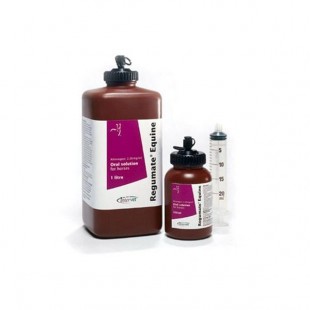
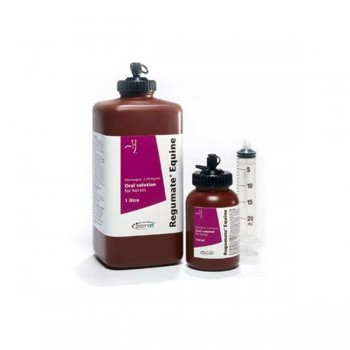
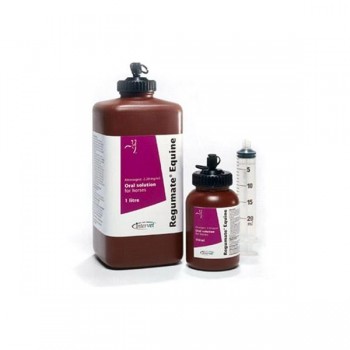
Regumate for Horses is an oral prescription medicine used to help manage the reproductive cycle of mares. The active ingredient, altrenogest, is a synthetic form of progesterone, the hormone that naturally supports the luteal phase of the cycle. When a mare is in season (oestrus), hormone levels fluctuate and some horses become uncomfortable, distracted, or difficult to handle, even if they seem physically sound.
VETERINARY PRESCRIPTION REQUIRED
Regumate is prescribed by a vet to suppress or control oestrus, so that training, transport, competition, and routine management can continue more smoothly and safely for horse and handler. Many owners use Regumate as part of a breeding programme, while others use it for mares whose seasonal behaviour affects welfare, confidence, or day-to-day handling. Some owners also use Regumate during periods when consistent handling is especially important. It can be particularly helpful for mares that become anxious or tense through their back when cycling. Although Regumate can make life easier, it is still a hormonal medication and should always be used under veterinary guidance, with the mare’s overall health, behaviour, and reproductive history taken into account.
Oestrus can show up differently in each mare, and the changes are not always obvious. Some mares remain calm but become more reactive when handled, while others show marked behavioural and physical signs linked to uterine tone and ovarian follicular activity. You might consider a discussion about Regumate if your mare repeatedly shows signs such as:
- She becomes unusually distracted, fidgety, or difficult to concentrate during work.
- She urinates frequently, squats, or “winks” her vulva when she is being ridden or led.
- She becomes sensitive through her flanks, back, or girth area and objects to being groomed or tacked up.
- She shows unpredictable irritability towards people or other horses, especially in close quarters.
- She loses performance consistency, particularly around other horses, without another clear cause that you can identify.
Regumate is not a sedative and it does not treat musculoskeletal pain, gastric ulceration, or other medical problems that can mimic season-related behaviour. Your vet may recommend a clinical examination and, where appropriate, a reproductive assessment to rule out issues such as ovarian tumours, persistent follicles, endometritis, or discomfort associated with the reproductive tract before starting Regumate.
Regumate works by providing a steady, progesterone-like signal to the mare’s endocrine system. In a natural cycle, progesterone from the corpus luteum feeds back to the hypothalamus and pituitary gland, reducing the release of gonadotrophins such as luteinising hormone (LH) and follicle-stimulating hormone (FSH). Altrenogest in Regumate mimics this effect, which helps prevent the final maturation of ovarian follicles and suppresses ovulation. Tthe mare is held in a luteal-like state, so she is less likely to display oestrus behaviour.
When Regumate is stopped, many mares return to normal cycling within a few days, although timing varies with individual physiology and the stage of the cycle at the start of treatment. Because Regumate influences the hypothalamic–pituitary–ovarian axis, it can be useful for synchronising groups of mares for breeding, teasing, or veterinary reproductive procedures, and it may help create a more predictable window for covering or insemination.
Regumate is given by mouth once daily, and it is usually supplied with a dosing syringe so the prescribed volume can be measured accurately. Many owners administer Regumate directly onto a small amount of feed, or onto the tongue, but it is important that the full dose is taken and that the timing is consistent each day. Hormonal therapies work best when they are routine, and missed or late doses can allow follicles to develop and season signs to break through. Your vet will advise how long Regumate should be used, whether it is for short-term suppression during a busy period or as part of a planned breeding schedule. If your mare is being managed for fertility, your vet may also discuss teasing, ultrasound monitoring of the ovaries and uterus, and the best time to discontinue Regumate. It is sensible to clean the syringe after use and avoid contaminating communal feed buckets, because small amounts of hormone can be transferred unintentionally.
Most mares tolerate Regumate well, but any medicine that alters hormone balance can have unwanted effects, and monitoring is reassuring. Possible changes include mild lethargy, appetite variation, transient mammary development, or a return of oestrus signs if the dose is not consistent. Rarely, you might notice vaginal discharge, changes in temperament, or signs that suggest uterine inflammation, and these should be discussed promptly with your vet. Regumate is intended for use in mares, and it is not appropriate for stallions, geldings, or immature animals. Your vet will also consider whether there is any risk of pregnancy and whether the mare has conditions where progestagen medicines should be used cautiously. If you compete, remember that altrenogest is a controlled substance in many equestrian disciplines, and withdrawal times can vary by organisation, so you should check the current rules before giving Regumate. If your horse is registered in the food chain, your vet can advise on the correct medicine records and any withdrawal periods.
Because Regumate contains a potent progestagen, careful handling protects the people looking after your horse. The liquid can be absorbed through the skin, so disposable gloves are recommended, and hands should be washed thoroughly after use. Women who are pregnant, trying to conceive, breastfeeding, or who have hormone-sensitive medical conditions should avoid handling Regumate, and any accidental skin contact should be cleaned immediately. Store Regumate securely, upright, and away from food preparation areas, and keep it out of reach of children. If there is a spill, absorb it with disposable paper, clean the area thoroughly, and dispose of waste safely so that other animals and people are not exposed. If your mare’s behaviour changes suddenly, if she shows signs of colic, abnormal discharge, or discomfort, or if Regumate does not seem to be controlling oestrus as expected, a review with your vet can help identify whether the issue is hormonal, pain-related, or behavioural, and whether the plan needs to be adjusted.
How does Regumate control a mare’s season?
Regumate contains altrenogest, a synthetic progestagen that acts like progesterone. It provides negative feedback to the hypothalamus and pituitary gland, reducing hormones that drive follicle development and ovulation. By holding the mare in a luteal-like state, visible oestrus behaviours are less likely.
How quickly does Regumate work, and when will my mare come back into season?
Many mares settle within a few days of starting Regumate, although individual response varies. After stopping, oestrus often returns within several days, but timing depends on where the mare is in her cycle and how her ovaries respond. Your vet can advise on expectations for your mare.
Can Regumate help with grumpy or distracted behaviour during riding?
Regumate can help if the behaviour is linked to oestrus, such as distractibility, irritability or sensitivity around other horses. It will not fix pain, poor saddle fit or gastric ulceration, which can look similar. If behaviour changes are new or severe, a veterinary examination is sensible.
How do I give Regumate safely?
Give Regumate exactly as your vet prescribes, at the same time each day, using the dosing syringe provided. Wear disposable gloves and wash hands afterwards, because altrenogest can be absorbed through the skin. Avoid contact if you are pregnant, breastfeeding or have hormone-sensitive conditions.
Can Regumate be used for breeding synchronisation?
Yes, Regumate is commonly used as part of a veterinary breeding plan to help synchronise oestrus in mares, which can make teasing, scanning and timed insemination more straightforward. It is not a fertility treatment on its own, so your vet may combine it with ultrasound monitoring and other reproductive management.