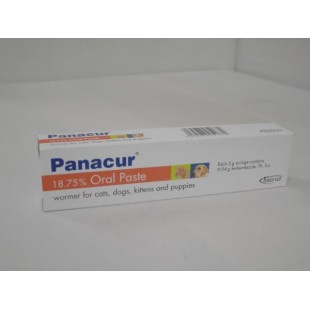
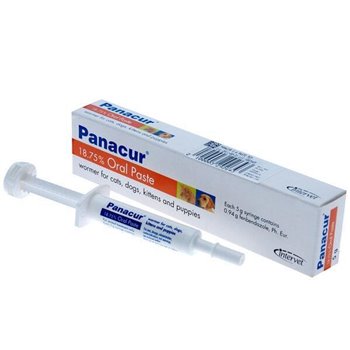
Panacur Worming Paste for Dogs
Panacur Worming Paste for Dogs is an oral worming treatment designed to help control common intestinal worms in dogs and puppies. It is supplied in a syringe containing a white, ready-to-use paste that is given by mouth. Many dogs dislike or refuse tablets, so a paste formulation offers a practical alternative for reliable worming at home under veterinary guidance.
Panacur Worming Paste contains the active ingredient fenbendazole. This is a broad-spectrum anthelmintic, which means it is effective against a wide range of common intestinal worms. It is typically used to treat and control roundworms and other nematodes that can live in a dog’s gut. In some situations, it may also be used as part of treatment plans for specific protozoal infections, such as Giardia, as directed by a veterinary surgeon.
The paste is suitable for use in puppies, adult dogs, and in certain cases breeding bitches, following professional advice. It is especially helpful for small dogs or very young puppies that are difficult to dose with standard tablets. Because the syringe is graduated, it allows the person giving the treatment to measure out a dose appropriate for the dog’s body weight.
How Panacur Worming Paste works
Fenbendazole, the active ingredient in Panacur Worming Paste, belongs to a group of medicines known as benzimidazoles. These substances interfere with the worms’ ability to take up energy and nutrients. Fenbendazole binds to structures within the parasite’s cells and disrupts their normal function. Without the ability to maintain their energy processes, the worms gradually die and are passed out of the dog’s body in the faeces.
This process is targeted at the worms and does not rely on paralysing them quickly. As a result, Panacur tends to act in a steady and controlled way. When used at the correct dose and frequency, and as part of a wider worm control programme, it helps to reduce the worm burden in the dog safely and effectively.
The importance of frequent worming in dogs
Regular worming is an essential part of routine dog care. Worms such as roundworms, hookworms, whipworms and some tapeworms can live in a dog’s intestines and feed on nutrients or blood. Over time, these parasites can cause a range of health problems. Signs may include diarrhoea, vomiting, weight loss, a pot-bellied appearance in puppies, a dull coat, and reduced energy. In severe cases, especially in young or vulnerable animals, heavy worm burdens can become life-threatening.
Worms are not only a risk for dogs themselves. Some species, such as Toxocara roundworms, can pose a potential risk to human health, particularly to children who may come into contact with contaminated soil or faeces. Reducing worm levels in dogs helps to reduce the level of eggs shed into the environment. This is important for protecting both the household and the wider community.
Dogs can pick up worms in many ways. They may ingest worm eggs or larvae from grass, soil, or puddles. They may eat small prey animals, such as rodents, which can carry immature worm stages. Fleas can transmit some types of tapeworm, and puppies can acquire worms from their mother before birth or through her milk. Because exposure is frequent and often unavoidable, a single treatment is not enough. Ongoing, scheduled worming is needed to keep the worm burden under control.
Recommended frequency of worming
General guidelines often suggest worming adult dogs at least every three months, or more frequently in higher-risk situations. Puppies usually require more frequent treatments because they are more prone to heavy worm burdens and reinfection. However, exact schedules can vary. Factors such as the dog’s age, lifestyle, diet, local parasite risk, and any underlying medical conditions all influence the most appropriate worming plan.
For this reason, it is important to follow the advice of a veterinary professional and the instructions given on the product packaging. A vet may recommend Panacur Worming Paste as part of a tailored plan that includes faecal testing, regular treatments, and additional parasite control where needed.
How to give Panacur Worming Paste
Panacur Worming Paste is administered orally. The syringe is usually marked with graduations that correspond to the dosage for a given body weight. The dog should be weighed as accurately as possible before treatment so that the correct amount of paste is given. The paste can be placed directly onto the back of the dog’s tongue using the syringe, or mixed into a small amount of food if the dog will reliably consume the full dose.
Treatments may be given as a single dose or over several consecutive days, depending on the indication and veterinary recommendation. It is important to complete the full course, even if the dog appears well. Stopping early may reduce effectiveness and allow worms to persist in the gut. After treatment, dogs should continue with a regular worming schedule to help prevent reinfection.
Panacur Worming Paste is most effective when it is used as part of a wider parasite control programme. Good hygiene plays a central role. Dog faeces should be picked up promptly and disposed of safely to limit contamination of gardens, parks, and public spaces. Hands should be washed after handling dogs or cleaning up after them, and children should be encouraged to wash their hands after playing outside.
Flea control is also important, since fleas play a role in the life cycle of some tapeworms. Regular flea treatments, combined with routine worming, help reduce the overall parasite load. Keeping kennels, bedding, and living areas clean and dry further limits the survival of parasite eggs and larvae in the environment.
For breeding bitches and puppies, specific worming strategies are often recommended to reduce the transfer of worms from mother to offspring. In these situations, vets may suggest precise dosing schedules and products such as Panacur Worming Paste, chosen for their suitability in young or pregnant animals. Careful adherence to these plans supports healthier litters and reduces the worm burden in the household over time.
By combining an appropriate worming product, such as Panacur Worming Paste for Dogs, with consistent hygiene, flea control, and veterinary advice, dog owners can play an active role in protecting their animals from the effects of intestinal worms and in helping to limit the spread of these parasites in the environment.