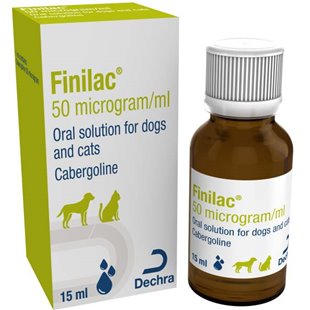
Finilac Oral Solution for Dogs and Cats contains cabergoline and is used to treat false pregnancy in female dogs and suppress milk production in female dogs and cats. It works by reducing prolactin, a hormone involved in lactation. Finilac can reduce milk production and associated physical changes in dogs with phantom pregnancy. In cats, its authorised purpose is suppression of lactation when this is required. Finilac is a prescription medicine, with treatment selected after a veterinary assessment.
False pregnancy, also called phantom pregnancy or pseudopregnancy, can develop after a dog's season even if she has not been mated. Signs may include nesting, mothering toys, swollen mammary glands, milk production and changes in appetite or behaviour. Mild episodes may settle without medication, while more pronounced signs can need treatment. Before Finilac is started, a genuine pregnancy must be ruled out: cabergoline can cause abortion and must not be given to pregnant anima...
Finilac Oral Solution for Dogs and Cats contains cabergoline and is used to treat false pregnancy in female dogs and suppress milk production in female dogs and cats. It works by reducing prolactin, a hormone involved in lactation. Finilac can reduce milk production and associated physical changes in dogs with phantom pregnancy. In cats, its authorised purpose is suppression of lactation when this is required. Finilac is a prescription medicine, with treatment selected after a veterinary assessment.
False pregnancy, also called phantom pregnancy or pseudopregnancy, can develop after a dog's season even if she has not been mated. Signs may include nesting, mothering toys, swollen mammary glands, milk production and changes in appetite or behaviour. Mild episodes may settle without medication, while more pronounced signs can need treatment. Before Finilac is started, a genuine pregnancy must be ruled out: cabergoline can cause abortion and must not be given to pregnant animals. Swelling or discharge should not automatically be attributed to a phantom pregnancy without examination.
Finilac reduces prolactin release from the pituitary gland. As the hormonal stimulus to produce milk falls, lactation decreases and enlarged mammary glands can reduce in size. It does not treat mammary infections. Painful, hot or inflamed glands, or an animal that is generally unwell, need veterinary attention. Finilac should only be used in an animal producing milk when stopping that milk production is intended. If puppies or kittens are still dependent on their mother's milk, their feeding needs must be addressed as part of the veterinary plan.
The solution contains 50 micrograms of cabergoline per millilitre. Finilac can be given directly into the mouth or mixed with food, which offers an alternative to direct administration. Use the oral syringe to measure the amount accurately. If mixed with food, make sure the treated portion is eaten by the intended animal; a shared bowl makes it difficult to confirm the dose.
The labelled Finilac course is once daily for four to six consecutive days, depending on the severity of the condition. Your vet will specify the dose and duration for your dog or cat. Keep track of milk production, mammary swelling and any behavioural changes during treatment. Do not squeeze the glands to check for milk, as stimulation can encourage further production. Preventing excessive licking and using calm distractions may also help a dog with false pregnancy. If signs remain or return, your vet can decide whether another course or further investigation is appropriate.
Finilac may cause vomiting, reduced appetite or drowsiness. Vomiting is often associated with the first dose and may not recur, but persistent or severe signs need veterinary advice. Cabergoline can temporarily lower blood pressure, and Finilac must not be used with blood-pressure-lowering medicines or dopamine antagonists such as metoclopramide. It must also not be given immediately after surgery while anaesthetic effects remain. Significant liver impairment requires caution. Tell your vet about current medicines and any planned procedure when discussing treatment.
What is Finilac used for in dogs?
Finilac is authorised to treat false pregnancy in female dogs and to suppress lactation when required. It reduces the hormone prolactin, which helps reduce milk production. Your vet will assess the symptoms and rule out genuine pregnancy before deciding whether treatment is needed.
Can Finilac be used in cats?
Yes. Its authorised use in female cats is suppression of lactation. It should not be given to a nursing cat unless stopping milk production is intended. If kittens are still relying on her milk, the vet will need to consider how they will be fed.
How much Finilac should I give?
The labelled dose is 0.1ml per kilogram of bodyweight once daily, equivalent to 5 micrograms of cabergoline per kilogram. Follow the volume on the dispensing label and use an accurate current weight. Do not estimate the dose from the bottle size.
Can I give Finilac with food?
Yes. The authorised instructions allow administration directly into the mouth or mixed with food. Check that the full treated portion is eaten. Finilac must not be mixed with other veterinary medicines or water-based liquids such as milk.
What if my pet vomits after a dose?
Vomiting can occur after the first administration and may not happen again. Contact your vet for advice if it is repeated, severe or accompanied by other signs. Do not automatically give another dose, because you cannot reliably judge how much was absorbed.
Can Finilac be given during pregnancy?
No. Finilac must not be used in pregnant animals because cabergoline can cause abortion. Distinguishing genuine pregnancy from false pregnancy is an essential part of the assessment. Tell your vet if mating could have occurred, even if it was not planned.
Does Finilac need a prescription?
Yes. Finilac is a POM-V medicine and requires a valid veterinary prescription. The vet confirms the diagnosis, checks suitability and sets the treatment course. It is not a routine product for preventing future phantom pregnancies or for stopping milk production without assessment.