


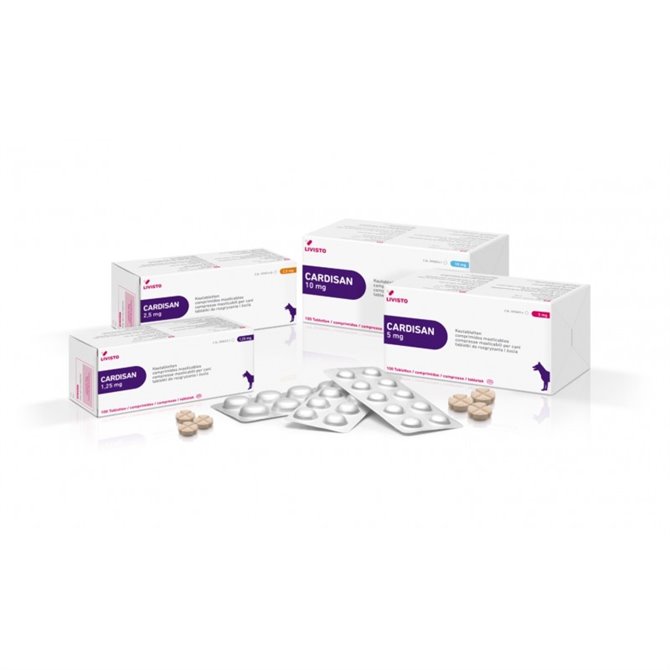
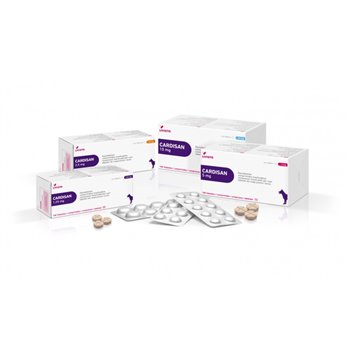
10mg Cardisan for Dogs - Per Tablet
10mg Cardisan is a prescription heart medicine for dogs that need extra support when their heart is struggling to pump effectively. Cardisan is commonly prescribed for dogs diagnosed with Congestive Heart Failure (CHF), most often linked to myxomatous mitral valve disease (a “leaky” valve that causes a heart murmur) or dilated cardiomyopathy (a weakened, enlarged heart muscle).
In CHF, the heart’s reduced pumping ability can lead to fluid build-up in the lungs or abdomen and can leave dogs tired, restless at night, or unable to enjoy normal routines. Your vet may prescribe 10mg Cardisan when they have confirmed heart disease with an examination and investigations such as echocardiography, chest x-rays, ECG, and blood pressure checks. Cardisan is not a cure for the underlying heart change, but it is designed to improve how the heart works and to support quality of life alongside good monitoring and a treatment plan.
VETERINARY PRESCRIPTION REQUIRED
Additional Product Information
Description
Cardisan contains pimobendan, and it belongs to a group of medicines often described as “inodilators”, meaning they support the heart’s pumping action while also helping blood vessels relax. In practical terms, 10mg Cardisan helps the heart contract more strongly (positive inotropy), which can improve cardiac output so oxygen and nutrients are delivered more efficiently around the body. At the same time, it reduces the resistance the heart has to pump against (afterload) by encouraging vasodilation, so each heartbeat can move blood forward with less effort. This combination can ease the back-pressure that contributes to congestion in the lungs and may reduce breathlessness and coughing when CHF is being managed. In pharmacology, pimobendan is known to increase contractility through calcium sensitisation and to promote vasodilation through phosphodiesterase inhibition, but you do not need to remember the terminology for the medicine to be helpful. What matters is that 10mg Cardisan supports the heart’s strength and circulation in a way your dog can often feel as better stamina and more comfortable breathing.
Congestive Heart Failure in dogs is not a single disease; it is a clinical syndrome that develops when the heart can no longer meet the body’s demands without causing fluid congestion. As cardiac output falls, the body tries to compensate by activating neurohormonal systems such as the renin–angiotensin–aldosterone system (RAAS), which constricts blood vessels and encourages salt and water retention. These compensations can be helpful at first, but over time they increase the heart’s workload and contribute to fluid build-up in the lungs (pulmonary oedema) or around the lungs (pleural effusion), and sometimes in the abdomen (ascites). This is why CHF can look like a breathing problem, a cough, or a dog that just seems “slower” and less keen to move. Your vet confirms the diagnosis using examination, chest radiographs, and echocardiography. 10mg Cardisan is used to support circulation and reduce the functional strain on an already challenged heart.
If your dog has CHF, noticing small changes early can make a real difference, because fluid congestion can worsen quickly and dogs are very good at quietly reducing activity to cope. Signs your vet may ask you to watch for include:
- coughing, especially at night, when lying down, or after resting
- faster breathing at rest, increased effort to breathe, or panting when the room is cool and your dog is calm
- reduced exercise tolerance, slowing down on walks, or reluctance to climb stairs
- fainting episodes (syncope), wobbliness, or sudden weakness
- reduced appetite, weight loss, or a general “not quite themselves” feeling
- a swollen belly from fluid build-up, or a pot-bellied appearance
Many vets recommend tracking resting respiratory rate at home and noting appetite, bodyweight, and energy levels, because these can be early indicators that fluid is returning. 10mg Cardisan supports the heart’s performance, but it works best when any shift in symptoms is picked up promptly, so that your vet can reassess, adjust companion medicines, and check for complications such as worsening valve regurgitation or a clinically significant arrhythmia. If your dog is struggling to breathe, seems distressed, or collapses, treat it as urgent and seek veterinary advice straight away.
10mg Cardisan is usually given by mouth exactly as your veterinary surgeon prescribes, and it is often used as part of combination therapy rather than on its own. A diuretic may be added to remove excess fluid, an ACE inhibitor or related medicine may be used to reduce RAAS-driven strain on the heart, and some dogs benefit from an aldosterone antagonist to help control longer-term remodelling and fluid retention. Your vet chooses the best combination based on your dog’s bodyweight, blood pressure, kidney values, electrolyte balance, and how stable their breathing is day to day. Follow the instructions on the label for 10mg Cardisan and keep doses consistent, because steady treatment helps your vet judge response and adjust safely. If you ever miss a dose of 10mg Cardisan, ask your practice for guidance rather than doubling the next dose. Many dogs with CHF also do well with sensible lifestyle support, such as avoiding sudden bursts of strenuous exercise and using a diet plan that suits their condition.
How does 10mg Cardisan work in congestive heart failure?
In canine CHF, the heart cannot maintain normal circulation without the body retaining fluid and narrowing blood vessels. 10mg Cardisan supports stronger heart contractions and reduces the workload the heart pumps against, which can improve cardiac output and help reduce congestion. Your vet may combine it with other heart medicines.
How quickly might I notice changes after starting 10mg Cardisan?
Some dogs seem brighter or less exercise-intolerant within days, while others improve more gradually over one to two weeks as fluid control and circulation stabilise. Response depends on the underlying heart condition and any companion medications. If breathing rate, cough, or energy worsens, contact your vet promptly.
Should 10mg Cardisan be given with food?
Follow your vet’s directions, as timing can matter. Many dogs are prescribed Cardisan at consistent times each day and it is often given away from meals, but individual plans vary. If your dog has a sensitive stomach, your vet can advise the safest routine without reducing benefit.
Can 10mg Cardisan be used alongside diuretics such as furosemide?
Yes, it is often used together as part of a CHF plan, because diuretics remove excess fluid while 10mg Cardisan supports pumping and circulation. The key is monitoring hydration, kidney values, and electrolytes, as diuretics can alter these. Always use the combination exactly as prescribed.
What are early signs that congestive heart failure is worsening?
Early warning signs include a rising resting respiratory rate, increased coughing at night, reduced stamina on walks, and needing more rest after mild activity. Some dogs show appetite changes or seem unsettled when lying down. If you see rapid breathing, blue gums, collapse, or severe distress, seek urgent veterinary help.
You may also like
What our customers say about us.
I always receive an excellent service from this company. The website is easy to navigate, the items are dispatched immediately and always delivered on time.
Janey
Source: Trustpilot Review
Ordering and payment were smoothly carried out, dispatch was timed to coincide with the delivery service to ensure the drugs reached me in a chilled state within the stated delivery time.
JB
Source: Trustpilot Review
Always prompt in order turn around, with a person at the end of a line to help when needed. I can only recommend their professionalism and reliability.
Mikey
Source: Trustpilot Review
- Tracked 24 Delivery Follow your parcel online
- VMD & RCVS Registered VetDispense is a registered UK Dispensary
- Secure Payment Pay securely online by card or PayPal
- Independent Since 2008 A Trusted UK Dispensary