


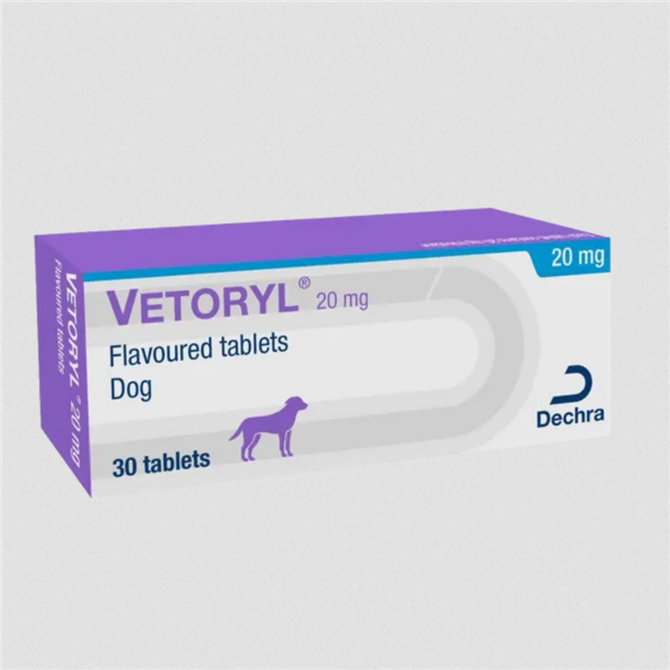
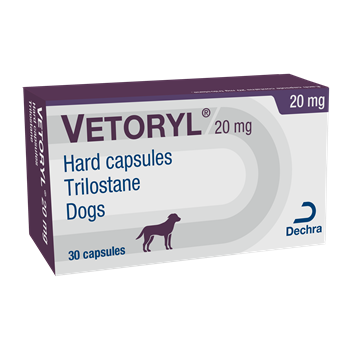
20mg Vetoryl Tablets for Dogs
Vetoryl 20mg Tablets are a prescription-only veterinary medicine used in the treatment of Cushing’s disease (also known as hyperadrenocorticism) in dogs.
Each Vetoryl 20mg Flavoured Tablet contains 20mg of trilostane, an active ingredient that helps regulate excessive hormone production in affected dogs. Vetoryl Tablets are designed to be given once daily with food and can be split in half for accurate dosing in dogs requiring smaller amounts.
Cushing’s disease is a common endocrine disorder in middle-aged and older dogs. It occurs when the adrenal glands produce too much cortisol, a steroid hormone that plays a role in stress response, immune function, and metabolism. While cortisol is essential in small amounts, overproduction leads to a range of symptoms that can reduce a dog’s quality of life. These symptoms often develop slowly, making the condition challenging to detect early.
VETERINARY PRESCRIPTION REQUIRED
Product Features
- Pack Size: - Pack of 30
- Target Animal: - Dog (Canine)
- Related Condition: - Cushing's Disease in Dogs
- Pet Prescription Required?: - Yes
- Active Ingredient: - trilostane
- Product Name: - 20mg Vetoryl Flavoured Tablets for Dogs
Additional Product Information
Description
Cushing’s disease develops when a dog is exposed to higher-than-normal cortisol for weeks, months or even years. The most common form is pituitary‑dependent hyperadrenocorticism, where the pituitary gland releases excess ACTH (adrenocorticotropic hormone) and continually stimulates the adrenal glands; less commonly, an adrenal tumour can drive cortisol production directly.
A similar pattern can also occur after prolonged use of corticosteroid medicines, sometimes described as iatrogenic Cushing’s. Signs often build slowly, so it helps to know what to look for. Common signs your vet may ask about include:
- increased thirst (polydipsia) and increased urination (polyuria), including accidents or waking at night
- increased appetite (polyphagia), scavenging, and weight gain with a pot‑bellied appearance
- panting, reduced stamina, and muscle weakness
- thinning hair coat, hair loss, fragile skin, or recurrent skin and ear infections
- slower wound healing and a general change in energy, behaviour, or sleep
Diagnosis usually combines a clinical examination with blood and urine tests, plus endocrine testing such as an ACTH stimulation test or a low‑dose dexamethasone suppression test, and sometimes imaging. Once confirmed, Vetoryl Tablets are used to reduce cortisol production and help ease these clinical signs.
Vetoryl Tablets work by limiting cortisol synthesis inside the adrenal glands. Trilostane (the active ingredient in 20mg Vetoryl Tablets) is a cortisol synthesis inhibitor that selectively inhibits the enzyme 3β‑hydroxysteroid dehydrogenase. This enzyme is part of the pathway that produces cortisol, so blocking it lowers cortisol output for part of the day. The aim is not to remove cortisol completely, because cortisol supports normal metabolism and stress responses, but to reduce excessive levels that are driving symptoms.
Your vet will calculate the starting dose based on your dog’s bodyweight and clinical status, and then fine‑tune it using both laboratory results and your observations at home. 20mg Vetoryl Tablets are generally given once daily with food, which can improve absorption and help keep dosing consistent. If your dog requires a dose that is not an exact whole tablet, the scored design can allow accurate splitting when your vet advises it, which is one reason some dogs do well on Vetoryl during the initial dose‑titration phase.
Monitoring is a normal part of safe treatment and often provides reassurance that your dog is responding as expected. In the early stages, your vet may schedule follow‑up visits to repeat hormone testing (commonly an ACTH stimulation test) and to check general health markers such as electrolytes, kidney values, liver enzymes and glucose, as well as urine testing for infection. These checks help confirm that 20mg Vetoryl Tablets are controlling cortisol without suppressing adrenal function too strongly. Like any medicine that affects hormone production, trilostane can sometimes cause adverse effects, particularly if the dose is higher than your dog needs. Contact your vet promptly if you notice vomiting, diarrhoea, loss of appetite, marked lethargy, weakness, wobbliness or collapse, or if your dog seems suddenly unwell. Your vet may recommend pausing the medication and reassessing, rather than continuing or changing the dose at home. Do not increase, decrease or stop 20mg Vetoryl Tablets abruptly unless your vet has advised you to do so.
Try to dose at the same time each day with a meal, and keep fresh water available at all times, especially while thirst and urination are still settling. Plan for extra toilet breaks in the first weeks, and consider waterproof bedding or easy‑to‑clean areas if accidents are happening. Many owners find it useful to keep a short diary of drinking, toileting, appetite, panting, bodyweight and activity, so you can share clear information at check‑ups. If you miss a dose, it is usually safer to wait and give the next scheduled dose rather than doubling up, but follow the specific advice your vet has given for your dog. Store the tablets as directed on the packaging and keep them out of reach of children and pets.
Some improvements, such as reduced thirst, less frequent urination and calmer panting, are often noticed within the first couple of weeks, while changes in skin thickness, muscle tone and coat regrowth may take longer because recovery is gradual and hair growth cycles are slow. It is also common for dogs with Cushing’s disease to have other conditions at the same time, such as arthritis, dental disease or diabetes mellitus, and your vet may adjust the overall plan to suit the whole dog rather than one diagnosis in isolation. During treatment, ongoing observation at home matters: if the original Cushing’s signs return, or if your dog seems unusually quiet, off food, or “not themselves”, it is worth checking in promptly. Most dogs stay on 20mg Vetoryl Tablets long term, with periodic review, because controlling cortisol is an ongoing process that can change as your dog ages over time.
What are 20mg Vetoryl Tablets used for in dogs?
Vetoryl Tablets are prescribed for dogs with Cushing’s disease (hyperadrenocorticism). They help reduce excessive cortisol made by the adrenal glands, which can ease signs such as increased thirst, frequent urination, panting and increased appetite. Your vet will confirm the diagnosis and set the dose.
How do 20mg Vetoryl Tablets work?
Vetoryl Tablets contain trilostane, which inhibits an adrenal enzyme involved in cortisol production (3β‑hydroxysteroid dehydrogenase). This lowers cortisol output for part of the day. The aim is controlled cortisol, not zero cortisol, so monitoring is used to keep the dose safe.
How quickly will my dog improve after starting Vetoryl Tablets?
Some dogs drink and urinate less within one to two weeks, and appetite or panting may start to settle around the same time. Skin and coat changes often take longer, sometimes a few months. Improvement depends on starting cortisol levels, other health conditions, and how the dose is adjusted.
What are the early signs of Cushing’s disease in dogs?
Early signs are often subtle and build over time. Many owners first notice increased thirst and urination, a hungrier dog, heavier panting, and reduced energy on walks. Over time, the abdomen may look rounder, the hair coat may thin, and skin infections can become more common.
Should 20mg Vetoryl Tablets be given with food?
Yes, they are commonly given with a meal, at the same time each day, because food can improve absorption and supports consistent dosing. Always follow your vet’s instructions, especially if your dog has a sensitive stomach or a specific feeding routine. Fresh water should remain available at all times.
What our customers say about us.
Quick efficient and professional. Product arrived promptly and well packaged
Steph
Source: Trustpilot Review
Definitely recommend great service very reasonable and fast delivery.
Jordan
Source: Trustpilot Review
Ordering and payment were smoothly carried out, dispatch was timed to coincide with the delivery service to ensure the drugs reached me in a chilled state within the stated delivery time.
JB
Source: Trustpilot Review
You may also like
- Tracked 24 Delivery Follow your parcel online
- VMD & RCVS Registered VetDispense is a registered UK Dispensary
- Secure Payment Pay securely online by card or PayPal
- Independent Since 2008 A Trusted UK Dispensary