


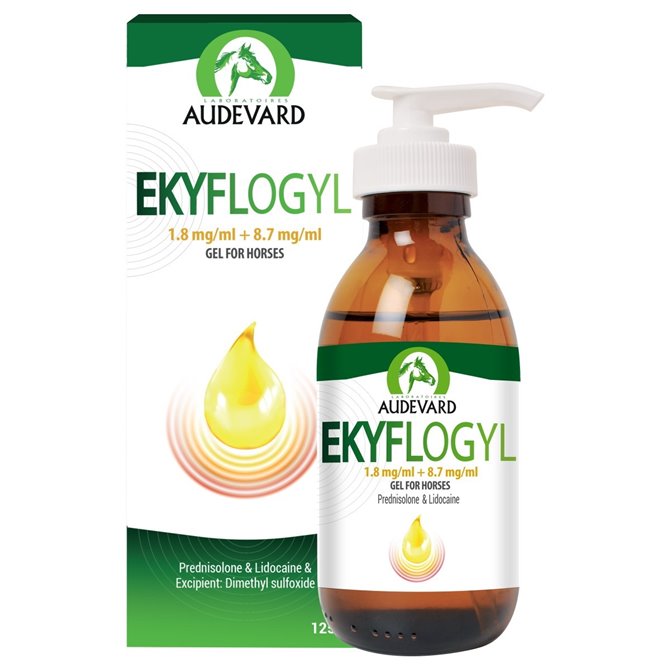
Ekyflogyl Gel for Horses - 125ml
Ekyflogyl Gel for Horses treats pain and inflammation associated with localised musculoskeletal disorders in non-food-producing horses. Its combination of prednisolone and lidocaine provides anti-inflammatory and local pain-relieving action when applied to the area prescribed by your vet.
The pump bottle helps measure the gel for brush application, and treatment must not exceed twelve days. Use only on intact, non-irritated skin and follow the protective-glove and handling instructions carefully. Ekyflogyl is a prescription medicine, so a veterinary prescription is required for purchase.
Product Features
- Pack Size: - 125ml Bottle
- Target Animal: - Horse (Equine)
- Pet Prescription Required?: - Yes
- Active Ingredient: - prednisolone, lidocaine, and dimethyl sulfoxide
Additional Product Information
Description
Ekyflogyl Gel for Horses is a prescription topical medicine for pain and inflammation associated with localised musculoskeletal disorders in non-food-producing horses. It combines prednisolone, a corticosteroid that reduces inflammation, with lidocaine, a local anaesthetic. The gel is applied to the area identified by the vet using a brush. Ekyflogyl Gel is intended for intact skin and must not be applied to irritated skin or open wounds. Local warmth, swelling or tenderness can have several causes, so veterinary assessment is needed before treatment begins.
A musculoskeletal disorder may involve muscles, tendons, ligaments, joints or the tissues around them. Inflammation can produce local heat, swelling and discomfort, while pain may change a horse’s movement or willingness to work. These observations help identify a problem but do not establish how severe it is or whether deeper structures are affected. Before prescribing Ekyflogyl Gel, the vet may examine the horse at rest and in movement and decide whether additional investigation is needed. Do not assume that a small external swelling represents a minor injury. Ekyflogyl Gel addresses pain and inflammation; improvement in comfort does not prove that an injured tendon or ligament has recovered its strength. Follow the prescribed rest and rehabilitation plan even if the horse appears more comfortable. A sudden deterioration, severe lameness or rapidly increasing swelling should be reported promptly rather than managed by adding extra gel or continuing normal exercise. Provide the vet with an accurate account of when the problem began and whether there was a fall, slip, change in workload or earlier episode. Photographs can help record visible swelling over time, but they cannot replace examination when the horse is deteriorating. If the horse is kept at livery, agree who will apply the medicine and record each application so that it is not repeated by another person. Keep the treatment instructions available to the people responsible for daily care. Ask the vet before changing exercise, turnout or dressings, because those decisions depend on the injury rather than the appearance of the skin alone.
Each millilitre of Ekyflogyl Gel contains 1.8mg of prednisolone and 8.7mg of lidocaine. Prednisolone reduces inflammatory activity, while lidocaine reduces local pain signalling. The formulation also contains dimethyl sulfoxide, usually called DMSO, which helps substances penetrate the skin and is listed as an excipient in the product information. This penetration-enhancing property is one reason to avoid combining Ekyflogyl Gel with other products, especially preparations applied to the same area. Do not add liniments, other medicated gels or household remedies unless the vet has changed the treatment plan. Tell the practice about medicines given by mouth or injection as well as anything already applied to the skin. The presence of a corticosteroid means that suitability cannot be judged simply by comparing the gel with a non-prescription cooling product. Your vet considers the horse’s diagnosis and wider health before deciding whether this combination is appropriate.
Apply Ekyflogyl Gel with a brush to the affected local area as directed by the vet. Prime the pump twice before the first use. The product directions describe 11–32ml per application, equivalent to six to eighteen pump actuations depending on the area, given twice daily. Use the amount prescribed for your horse rather than choosing an arbitrary number of pumps. A non-compressive dressing may be used when advised, but the site should not be tightly wrapped without veterinary direction. Ekyflogyl Gel must not be used for more than twelve days. Do not apply it to broken or irritated skin, and prevent the horse or another animal from licking the treated area. If the planned application site develops a wound, becomes irritated or cannot be kept from being licked, contact the practice before the next application.
Wear impermeable single-use protective gloves when applying Ekyflogyl Gel or touching the treated area. Pregnant women must not handle the product. Children must not touch the treated horse during treatment or for twelve days after treatment has ended. These precautions apply even though the medicine is applied externally, and everyone who handles the horse should be told about them. Keep Ekyflogyl Gel away from skin and eyes, wash your hands after use and follow the leaflet’s instructions if accidental contact occurs. Seek medical advice if the product is swallowed or irritation persists. The medicine must not be used in horses with impaired liver or kidney function, ongoing viral or fungal infections, or a compromised immune system. It is also unsuitable for pregnant or lactating mares. Tell the vet about any relevant diagnosis or new illness before treatment starts, including information held by another practice involved in the horse’s care.
Check the application area while using Ekyflogyl Gel and report unexpected heat, pain, swelling, hair loss, scaling or other skin changes to the vet. Such local reactions are recognised in the product information, and a worsening area needs assessment rather than continued application without advice. Ekyflogyl Gel is authorised only for horses that are not intended for human consumption. If your horse competes, speak to the prescribing vet about the relevant competition rules and planning before treatment; an estimate based on another medicine or another horse is unreliable. Store the bottle below 30°C in its outer carton to protect it from light. Lock the pump after use, keep it away from children and animals, and record the opening date. Use the contents within thirty days of first opening and before the printed expiry. Return unused medicine through an appropriate collection service, following the dispensing team’s advice. Keep a written record of the final application date so everyone knows when the handling restrictions end.
What is Ekyflogyl Gel used for in horses?
Ekyflogyl is a prescription gel for pain and inflammation associated with localised musculoskeletal disorders in non-food-producing horses. It contains prednisolone and lidocaine and is applied to intact skin. Your vet identifies the problem and specifies the application area, quantity and duration, together with any rest or rehabilitation instructions.
What are the active ingredients in Ekyflogyl?
Each millilitre contains prednisolone 1.8mg and lidocaine 8.7mg. Prednisolone is a corticosteroid with anti-inflammatory action, while lidocaine provides local anaesthesia. DMSO is also present as an excipient that helps skin penetration, which contributes to the need for careful handling and avoidance of other products on the area.
Can I apply Ekyflogyl to a cut or open wound?
No. Ekyflogyl must not be applied to broken or irritated skin. It is prescribed for localised musculoskeletal pain and inflammation, not routine wound treatment. If the intended application area develops a wound or irritation, contact your vet before continuing rather than applying gel over the damaged skin.
How often should Ekyflogyl be applied?
The product directions specify twice-daily application, with the amount based on the treated area and your vet’s prescription. Prime the pump twice before first use and apply with a brush. Do not choose the dose solely from the bottle size, and do not treat for longer than twelve days.
Do I need gloves when using Ekyflogyl Gel?
Yes. Wear impermeable single-use protective gloves when applying the gel or touching the treated area. Pregnant women must not handle it. Wash your hands afterwards and follow the leaflet if accidental exposure occurs. Everyone responsible for handling or caring for the horse should know these precautions.
Can Ekyflogyl be combined with another gel or liniment?
Do not use Ekyflogyl with other products, particularly topical preparations on the same area. Its DMSO content can increase skin penetration. Tell the vet about all gels, liniments and medicines already used, and obtain a revised treatment plan rather than layering another product over the gel.
What our customers say about us.
Always dispensed very quickly according to any instructions I may have sent .Very reliable company .
Joni
Source: Trustpilot Review
Always amazing and very efficient.
Julie K
Source: Trustpilot Review
Good prices, super fast delivery. Considering its pwt medication it comes so quickly and emails and quick also.
Nicolle
Source: Trustpilot Review
You may also like
- Tracked 24 Delivery Follow your parcel online
- VMD & RCVS Registered VetDispense is a registered UK Dispensary
- Secure Payment Pay securely online by card or PayPal
- Independent Since 2008 A Trusted UK Dispensary