


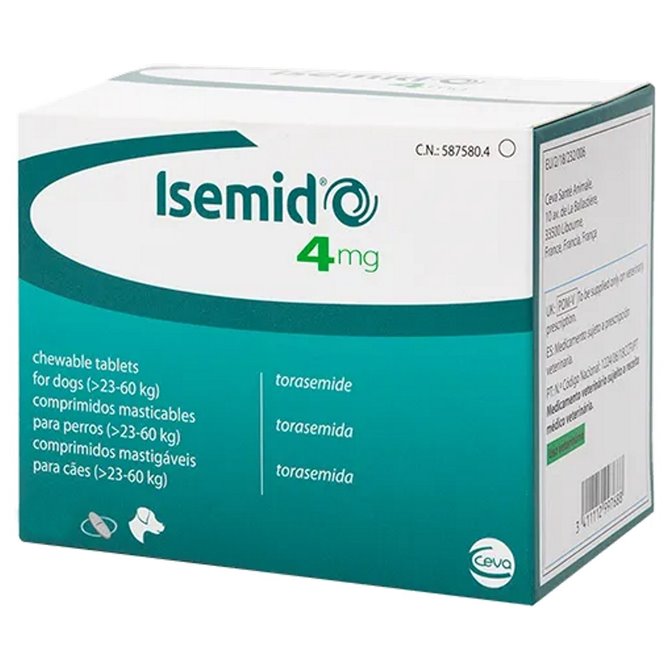
4mg Isemid Tablet for Dogs - Sold Individually
Isemid 4mg Chewable Tablets for Dogs helps relieve fluid congestion associated with Congestive Heart Failure, including pulmonary oedema. Containing torasemide, Isemid encourages the kidneys to remove excess salt and water, reducing the fluid burden that can make breathing uncomfortable.
The flavoured tablet is given once daily and can be divided into halves when prescribed. It may be accepted voluntarily or offered with food, providing convenient oral treatment for larger dogs. The 4mg presentation is designed for dogs weighing over 23kg and up to 60kg. Tablets are supplied individually, so you can order the quantity shown on your veterinary prescription.
Product Features
- Pack Size: - Sold Individually
- Target Animal: - Dog (Canine)
- Related Condition: - Congestive heart failure in Dogs
- Pet Prescription Required?: - Yes
- Active Ingredient: - Torsemide
- Product Name: - 4mg Isemid for Dogs
Additional Product Information
Description
Isemid 4mg Chewable Tablets for Dogs treats the clinical signs of Congestive Heart Failure, including fluid accumulation in the lungs. Each tablet contains 4mg of torasemide, a prescription diuretic that helps the kidneys remove excess salt and water from the body. Reducing this fluid burden can help relieve the congestion responsible for difficult breathing and reduced comfort. Isemid 4mg is a flavoured, once-daily tablet, with a score line that allows division into halves when prescribed. The 4mg presentation is intended for dogs weighing more than 23kg and up to 60kg, with the number of whole or half tablets determined by the prescribed dose.
Congestive Heart Failure occurs when heart disease leads to fluid congestion and associated clinical signs. Fluid can accumulate in the lung tissue and air spaces, a condition called pulmonary oedema, making breathing more difficult. A dog may breathe faster while resting, seem less able to exercise or struggle to settle comfortably. These changes are different from a heart murmur alone: a murmur describes a sound heard during examination, while congestive failure describes a clinical consequence of heart disease. Isemid 4mg is prescribed to address the fluid component of this condition. It may be used alongside other heart medicines that act differently, such as improving cardiac contraction or modifying hormonal responses. Isemid 4mg helps remove excess fluid through the kidneys rather than acting directly as a heart stimulant. The choice of accompanying medicines depends on the diagnosis, examination findings and how the dog responds to treatment. Pulmonary oedema affects the lungs’ ability to exchange gases effectively, so relieving fluid congestion can make a substantial difference to breathing comfort. The underlying heart problem still determines which other treatment is needed. A dog may have a plan covering fluid removal, heart function and activity, with each part serving a separate purpose. When discussing progress, describe whether the dog sleeps comfortably, how breathing looks at rest and whether normal gentle activity has changed. These observations are more informative than simply noting whether a cough is present, because several conditions can cause coughing and a cough alone does not measure the severity of congestion.
Torasemide is a loop diuretic, named after the part of the kidney where it works. Within the loop of Henle, it reduces the reabsorption of sodium and chloride, allowing more salt and water to leave the body in urine. Isemid 4mg therefore increases urine production as part of its intended action. Dogs may drink more and need more frequent opportunities to go outside. Fresh water should remain freely available so that the dog can respond to increased thirst. Torasemide has a longer-lasting diuretic action than furosemide, which allows the licensed once-daily dosing schedule. Isemid 4mg and furosemide are different medicines, however, and their doses cannot be exchanged milligram for milligram. The response to torasemide can also increase with repeated dosing, so the amount required after stabilisation may differ from the amount used earlier in treatment. The aim is to control congestion using the lowest effective prescribed dose.
Give Isemid 4mg once daily according to the dispensing label. Its pork-liver flavour may encourage voluntary acceptance, while giving it with food is another option. If the prescribed amount includes half a tablet, use the score line and return the remaining half to the blister for the next administration. Keep the blister inside the original carton, where the strength and dispensing instructions remain easy to identify. Isemid 4mg is available alongside smaller strengths, so check the tablet strength whenever a prescription changes. The number of tablets alone does not describe the dose. During a deterioration, a vet may prescribe a temporary higher dose; the licensed higher-dose range is limited to a maximum of five days before reduction and reassessment. Owners should follow the specific plan rather than increasing tablets when breathing appears worse. Acute breathing difficulty can require emergency treatment with injectable medicines before oral diuretic therapy is appropriate.
Monitoring during Isemid 4mg treatment assesses both relief of congestion and the effect on the kidneys and circulation. Blood tests can measure urea, creatinine and electrolytes, while urine testing may include a protein-to-creatinine ratio. Electrolytes are minerals such as sodium and potassium that help regulate normal body functions. Diuresis changes fluid and mineral balance, making these results useful even when breathing appears more comfortable. Isemid 4mg must not be used in dogs with renal failure, dehydration, low circulating blood volume or low blood pressure, and it must not be combined with another loop diuretic. Diabetes requires additional consideration. Appetite loss, vomiting, unusual lethargy or weakness should be reported promptly, as kidney function may need reassessment. Tell the vet about all medicines, especially anti-inflammatory painkillers, corticosteroids and other cardiovascular treatment. Renal changes and electrolyte disturbances are recognised adverse effects, while vomiting, diarrhoea, increased thirst and urinary accidents can also occur.
At home, a record of your dog’s sleeping or resting breathing rate can help the practice assess changes during treatment with Isemid 4mg. Ask the vet to demonstrate how to count breaths and set an individual threshold for contacting the practice. Count when the dog is settled rather than panting after exercise, and record the circumstances as well as the number. A noticeable increase from the usual pattern deserves advice; laboured breathing, collapse or severe distress needs urgent attention. Isemid 4mg tablets are flavoured, so store them securely where animals cannot help themselves to extra doses. No special storage conditions are required, but the original blister and carton should be retained. Wash your hands after handling, and seek medical advice immediately if a person accidentally swallows the medicine. Use in pregnant, nursing or breeding dogs is not recommended. When arranging a repeat supply, order the prescribed number of individual tablets and check whether the current instructions have changed.
What is Isemid 4mg used for in dogs?
Isemid 4mg treats clinical signs of congestive heart failure, including pulmonary oedema, where fluid accumulates in the lungs. It contains torasemide, a loop diuretic that increases salt and water removal through the kidneys. The prescribed amount depends on the dog’s weight, condition and response to treatment.
Does Isemid make a dog urinate more?
Yes. Increased urine production is part of torasemide’s diuretic action. Your dog may also drink more and need additional toilet breaks. Keep fresh water freely available. Report unusual weakness, poor appetite, vomiting or marked changes in drinking to the vet, because fluid balance and kidney function may need reassessment.
Can Isemid 4mg tablets be split?
Isemid 4mg chewable tablets are scored and can be divided into halves when the prescription requires this. Return the unused half to its blister and give it at the next administration. Do not assume that the same splitting instructions apply to another brand or a different heart medicine.
Should I give Isemid with food?
Isemid can be given with or without food. Some dogs accept the flavoured chewable tablet voluntarily; otherwise it can be offered with food or directly into the mouth. Follow the prescribed once-daily schedule and confirm that the dose has been swallowed rather than left in the food bowl.
Is Isemid the same as furosemide?
Both are loop diuretics, but Isemid contains torasemide and has a different potency and duration of action. Their doses are not interchangeable milligram for milligram. Isemid must not be given together with another loop diuretic, and any switch needs a specific veterinary plan rather than a direct tablet substitution.
Can I give extra Isemid if my dog starts breathing faster?
Do not increase the dose independently. Contact your vet promptly about faster resting breathing or a change in effort. Severe breathing difficulty requires emergency care and may need injectable treatment. A temporary higher oral dose is sometimes prescribed, but its amount and duration must be explicitly directed by the vet.
What our customers say about us.
Good prices, super fast delivery. Considering its pwt medication it comes so quickly and emails and quick also.
Nicolle
Source: Trustpilot Review
Always dispensed very quickly according to any instructions I may have sent .Very reliable company .
Joni
Source: Trustpilot Review
Very easy and efficient way of ordering prescription meds for my dog. Much cheaper than buying from the vets.
Ian
Source: Trustpilot Review
You may also like
- Tracked 24 Delivery Follow your parcel online
- VMD & RCVS Registered VetDispense is a registered UK Dispensary
- Secure Payment Pay securely online by card or PayPal
- Independent Since 2008 A Trusted UK Dispensary